
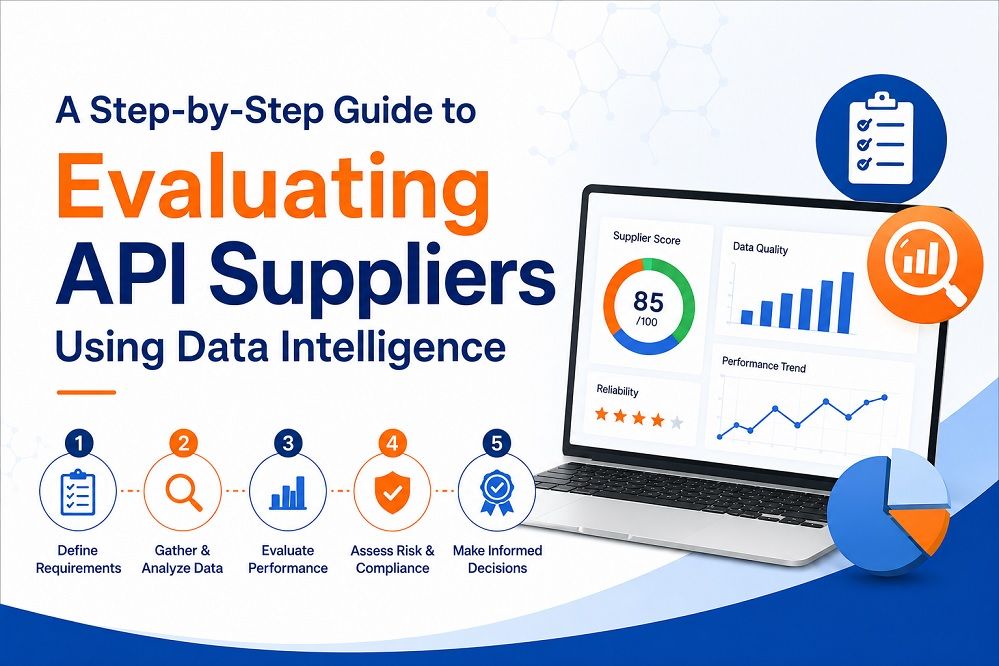
Data intelligence can be a strong weapon in the assessment of API suppliers. Data intelligence is a game-changer when it comes to assessing API suppliers.
In the pharmaceutical sector, choosing high-quality and reliable Active Pharmaceutical Ingredients (API) suppliers is crucial for guaranteeing product quality, compliance with regulations, and maintaining supply chain robustness. Pharmaceutical companies do not have time in the complex global business supply chain for manual audits, spreadsheets or limited supplier databases to qualify suppliers.
In today's day and age, organizations are relying on API & Supplier Intelligence to make better sourcing decisions. It can facilitate data intelligence, procurement, data quality, regulatory and business development to identify trusted suppliers, assess risks, monitor compliance and establish strong supply chains.
An approach to assess API suppliers step-by-step and practically using data intelligence. Data Intelligence's role in API Supplier selection.
Evaluation of an API supplier is no longer a procurement process. It is a strategic process and impacts the time to market, regulatory approval, manufacturing continuity and competitiveness to the market.
There are a number of drawbacks to commonly used means of supplier selection:
• A lack of visibility of suppliers' performance
• Incomplete regulatory information
• No on-the-fly risk monitoring. No live risk monitoring.
• Comparing the various suppliers of different countries is challenging.
• Time-consuming qualification processes
The answer to these challenges is data intelligence which can collect data from various suppliers, regulatory authorities, manufacturing process, inspection records and market intelligence and put them all together to make a decision.
Thus, the pharmaceutical industry will be able to reduce the risk of sourcing and improve the selection of the supplier.
Step 1: Define Supplier Qualification Requirements
There is a need to define the requirements of the organization prior to evaluating suppliers.
Stakeholders from procurement, quality assurance, regulatory affairs, manufacturing, and research should be involved in this process.
Common elements of key qualifications tend to be:
• API specifications
• Regulatory requirements
• Quality standards
• Manufacturing capacity
• Geographic preferences
• Documentation requirements
• Supply continuity expectations
Well-defined requirements enable organizations to select suppliers in accordance to both technical and commercial goals.
Step 2: Build a Qualified Supplier Shortlist
After determining the qualification criteria, the next step is to identify the possible suppliers.
API & Supplier Intelligence platforms can help organisations narrow down their shortlist of potential APIs & Suppliers with the following criteria:
• API manufacturing expertise
• Product portfolio
• Regulatory approvals
• Manufacturing locations
• Global market presence
• Therapeutic area specialization
Companies can discover qualified suppliers more efficiently using data-driven supplier discovery, which is more efficient than traditional supplier discovery.
It also identifies alternative suppliers that are not currently known via the traditional procurement process.
Step 3: Verify Regulatory and Quality Compliance
Among the important deciding factors in API supplier evaluations is the regulatory compliance.
Organizations should review:
• GMP certifications
• Drug Master Files (DMFs)
• All students must have a Certificate of Suitability (CEP).
• Regulatory inspection history
• Fill out warning letters and observations
• Quality management systems
Any supplier with a great compliance history will be more likely to allow his/her long term manufacturing and commercialization goals.
This is easier with data intelligence platforms, which can centralize compliance-related data from multiple regulatory sources and present the data in a structured format.
Step 4: Assess Supplier Risk
All suppliers carry a level of risk in terms of compliance and operation.
The following should be taken into account during a comprehensive risk assessment:
Compliance Risk
Inspection Report, Warning Letters and Quality Observations can be used to provide input into potential compliance problems.
Geographic Risk
Supply continuity could be interrupted due to political instability, trade restrictions, natural disaster and regional disruption.
Supply Chain Risk
The organization should know what sourcing system and dependence that the supplier has, depending on the supplier.
Capacity Risk
In the event that there is a high need, the manufacturing could have a limited supply.
Business Risk
Suppliers may not be able to ensure a continual supply due to financial instability and operational issues.
The combination of several risk indicators can benefit a firm in developing a comprehensive supplier risk profile.
Step 5: Evaluate Manufacturing Capabilities and Capacity
The supplier's manufacturing capacity is a very critical asset for long term success.
The following should be taken into account in assessing:
• Production capacity
• Facility infrastructure
• Technology platforms
• Manufacturing flexibility
• Product complexity expertise
• Scalability potential
Suppliers who will be able to grow will be able to be more valuable than others who can only satisfy the current demand.
Data intelligence can help compare manufacturing capabilities of several suppliers, identify the best long-term supplier partners.
Step 6: Conduct Due Diligence and Qualification
Once the list of suppliers has been reduced to a shortlist, organisations should formally evaluate the suppliers.
A well-defined process often consists of:
1. Supplier pre-screening
2. Documentation review
3. Quality questionnaires
4. Risk assessment
5. Site audits
6. Sample evaluation
7. Final approval
This stage is intended to validate information obtained during the earlier stages of the evaluation process, and to confirm that the supplier will be able to consistently meet the organizational need.
Supplier qualification is both data derived and verified in the field.
Step 7: Implement Continuous Supplier Monitoring
The evaluation of suppliers is not limited to the approval.
A continuous monitoring approach can help an organisation identify emerging risks in time to prevent the risk from impacting operations.
The most important monitoring zones are:
• Regulatory updates
• Inspection outcomes
• Quality events
• Manufacturing changes
• Capacity fluctuations
• Supply disruptions
Continuous monitoring enables organizations to ensure suppliers continue to perform as they do and to predict market changes.
API & Supplier Intelligence solutions today provide teams with real-time visibility into supplier activity, helping them to make faster and more informed decisions.
Clival Database helps in API & Supplier Intelligence?
Evaluating APIs suppliers is an essential process which demands trustworthy and useful knowledge.
With a comprehensive suite of intelligence capabilities, Clival Database helps pharmaceutical and biotechnology companies assess and make more informed decisions on suppliers.
Clival can be used by teams to:
Know about and compare API providers.Look for and locate API providers.
• Monitor supplier-related intelligence
• Track regulatory developments
• Analyze competitive landscapes
Assess activities of sponsors/ pipeline activities
Help make strategic sourcing decisions.
Recognise opportunities and risks.
Clival's seamless integration of supplier intelligence with a wider picture of the pharmaceutical market helps businesses make informed sourcing and partnership decisions with greater confidence.
Clival is not a database, it's a strategic tool for procurement, competitive intelligence, business development and market research teams.